Graphing FuRootkit Infrastructure Rapid Infra Mapping & IOC Blocklist
FuRootkit is not a single binary, it’s an infrastructure. Our Graphing FuRootkit Infrastructure service builds an actionable map of how this rootkit’s campaign is assembled (drop points → loaders → kernel hooks → C2/beacons → persistence), so defenders can see choke points, prioritize takedowns, and automate containment without calling out any mapping product names.
FuRootkit is not a single binary it’s an infrastructure. Our Graphing FuRootkit Infrastructure service builds an actionable map of how this rootkit’s campaign is assembled (drop points → loaders → kernel hooks → C2/beacons → persistence), so defenders can see choke points, prioritize takedowns, and automate containment without calling out any mapping product names.
Why map a rootkit infrastructure?
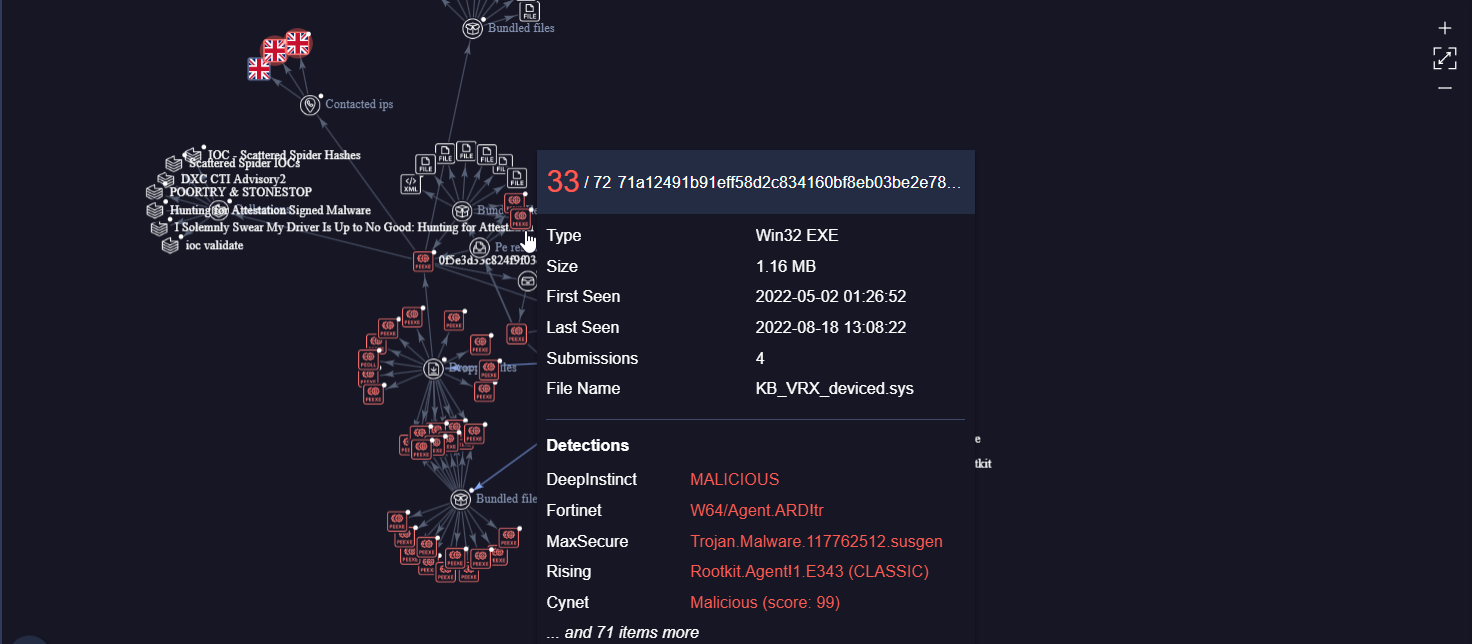
Rootkits live in layers: userspace droppers and installers, kernel modules or drivers, and distributed C2 and staging hosts. Mapping uncovers:
Persistent infrastructure nodes that matter most (C2 clusters, artifact-hosting providers, paste/raw endpoints).
Attack paths from initial delivery to kernel-level persistence.
Re-usable artifacts (same certs, imports, filenames) that speed detection across environments.
Mapping turns a noisy IOC list into a prioritized remediation plan.
Key Static Findings (PEStudio highlights)
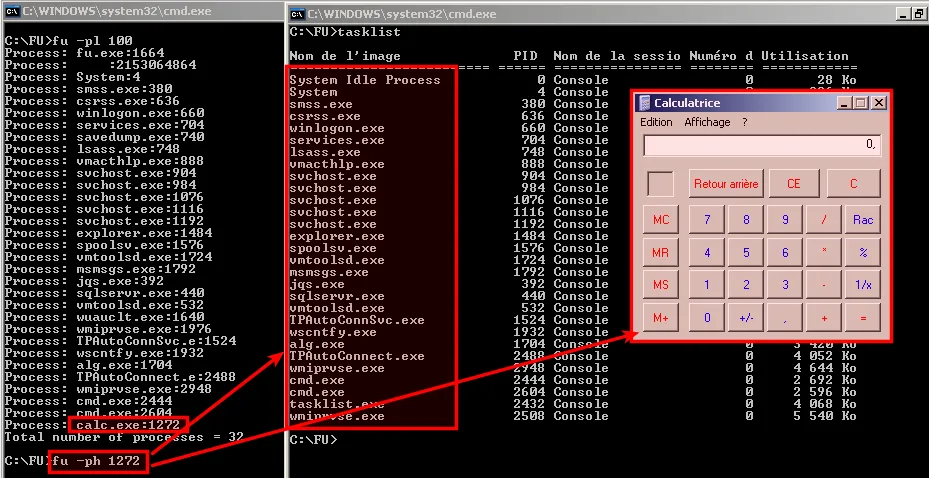
A quick static analysis of a representative FuRootkit sample (PEStudio-style review) showed several red flags that should be triaged immediately:
AV Detections: ~41 antivirus engines flag the sample as malicious a high consensus that indicates a widely recognized malicious binary.
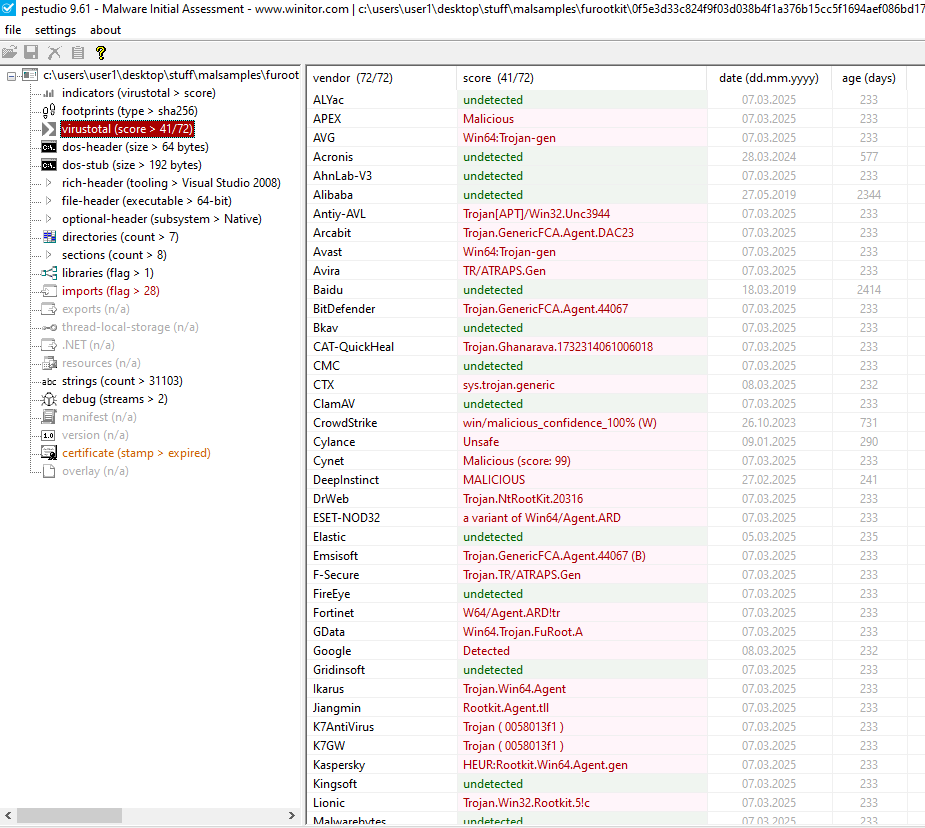
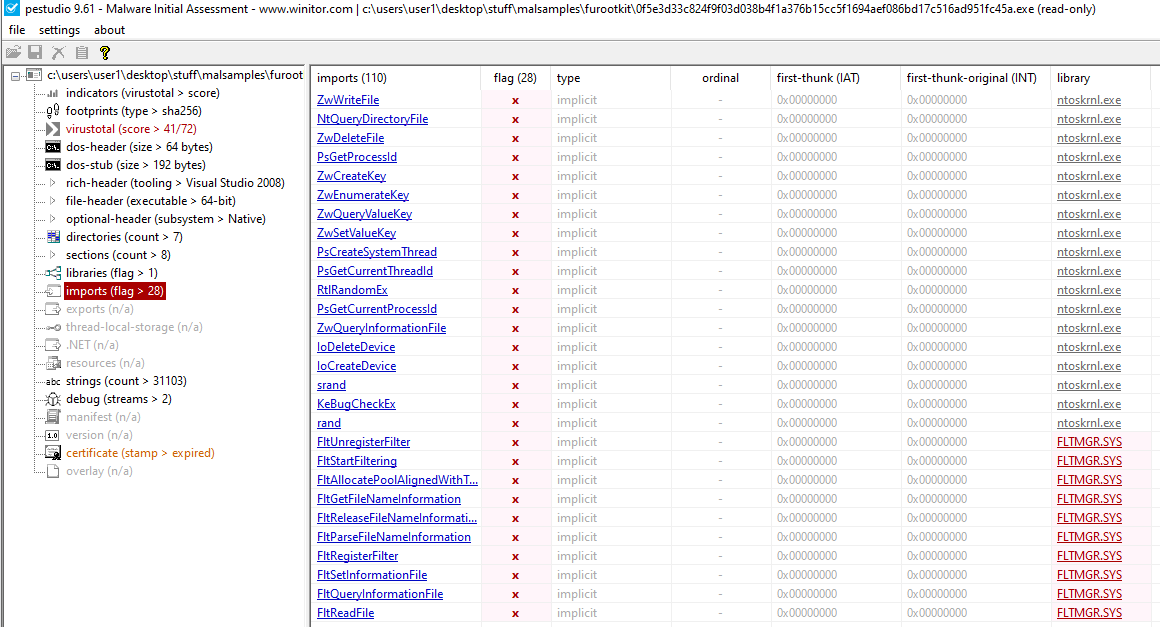
Suspicious imports (28 marked malicious): PEStudio-style analysis highlights numerous dangerous kernel and low-level APIs often used by rootkits, including ZwWriteFile, IoCreateDevice, and suspicious randomness/obfuscation calls like rand, indicative of direct disk/driver manipulation and stealth techniques.
Certificate issues: the sample contains an expired code-signing certificate, reducing any claim of legitimacy and strengthening the case for blocking and takedown.
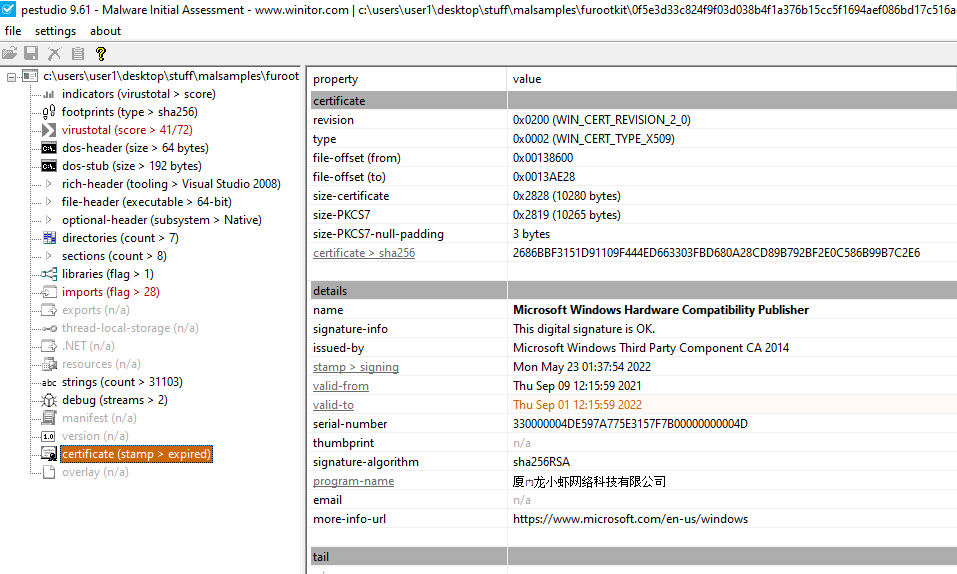
These static signals (high AV consensus, kernel APIs, expired cert) strongly increase confidence the sample is malicious and justify urgent containment and hunting.
Compact IOC table format
Below is a concise, narrow-format IOC table designed for quick ingestion into firewalls, proxies, EDR, and SIEM. Use the hxxp and bracketed-dot notation when sharing outside of automated ingestion to avoid accidental clicks; convert to real URLs/IPs only in safe, controlled tooling and sandboxes.
| Category | FuRootkit SHA‑256 Sample |
|---|---|
| Sample 1 | f62ce3383afe1b36d60c834b9e6bd09263fb8794c626bc42fcbb25a062e76c42 |
| Sample 2 | ed516fc2448dad8c157d2ff3d23088bf25fd92ecd809a1f01ec41c927c2cb5ec |
| Sample 3 | 6e6acc00afdb254d855c1adc5f27386ccfd398f4d893c44238c6ac596f8a3132 |
| Sample 4 | 9114dc1c44f6a1b7d63ca95e04541d833c49a3e65a717471042bd0ec19a3eb99 |
| Sample 5 | 6a0390769feeb703962e81f70896a1dfd1ea14479b9e200bcc530b238990c759 |
| Sample 6 | 478919d31d12026fe9ee51d1332701cd5e350b33d2bcf9365b462a1a25d56680 |
| Sample 7 | 142c6f5b7079f87e65df022f5fccfe229a0f41803c0d3eee42d38ed09eb73b86 |
| Sample 8 | 10cf63dce9ea260f48def203313edcec06a293db3e35589954a99582c0a7e1d2 |
| Sample 9 | 0f5e3d33c824f9f03d038b4f1a376b15cc5f1694aef086bd17c516ad951fc45a |
| Sample 10 | 03e903602037420acf4d1bc5084923c59385c5594f3a2de6fcf320bd4746d6c7 |
The hashes in the table above are illustrative, not indicators harvested from a live campaign. Take the exact hashes from your own sample before ingesting anything into a blocklist.
Tactical steps we recommend
1. Immediate containment: block the listed IPs/domains at perimeter and proxy; blacklist filenames and service names at EDR.
2. Hunt for kernel artifacts: query for unsigned or expired-signed drivers, services created recently, and processes using ZwWriteFile/IoCreateDevice.
3. Isolate and image endpoints that show signs of persistence for full forensic triage, rootkits can survive reboots and hide in driver/service layers.
4. Replace/rollback compromised certs: if your supply chain uses code signing, ensure revoked/expired certs aren’t accepted by your internal validation.
5. Upstream abuse & takedown: file abuse reports for hosting providers serving listed C2 endpoints; provide time-stamped evidence and samples.
6. User/installer controls: block execution from common staging folders, restrict driver/service installation to approved code-signers, and enforce least privilege for service installation.
What our Graphing FuRootkit Infrastructure service delivers
A visual, prioritized infrastructure graph showing delivery vectors, staging hosts, beacon clusters, and persistence nodes.
Actionable blocklists (IPs, URLs, hashes, registry keys, filenames) exportable to your firewall/proxy/EDR in CSV/STIX/JSON.
Hunt playbooks and SIEM/EDR queries targeting the dangerous imports and behaviors (e.g., kernel API use, driver loads).
Takedown kit (provider contacts, timestamps, forensic evidence) for high-value C2 nodes.
Final note
High AV consensus (≈41 engines), kernel-level imports (ZwWriteFile, IoCreateDevice, etc.), and an expired certificate together form a strong case that a sample is malicious and engineered for stealth and persistence. Mapping the full infrastructure, not just the file, lets you stop the campaign strategically, not just react to single artifacts.