Mapping GodRouter Backdoor: Understanding FunnySwitch Backdoor and Defend Against It
In the world of cybersecurity, protecting your network and critical infrastructure from advanced persistent threats (APTs) is paramount.

In the world of cybersecurity, protecting your network and critical infrastructure from advanced persistent threats (APTs) is paramount. One such threat that has gained increasing attention recently is the FunnySwitch backdoor, also known as the GodRouter backdoor. This sophisticated malware has been linked to a notorious hacking group known as Winnti, notorious for intellectual property theft and other forms of cyber espionage. In this blog post, we’ll explore the infrastructure mapping of the FunnySwitch backdoor and share key Indicators of Compromise (IOCs) that every organization needs to block to safeguard their network.
What Is the FunnySwitch Backdoor (aka GodRouter)?
The FunnySwitch backdoor is a piece of malware that allows hackers to gain remote access to compromised systems, often providing them with the ability to execute arbitrary code, steal sensitive information, and maintain persistence in the victim’s environment.
This backdoor has been tied to the Winnti hacking group, known for their cyber-espionage operations and extensive use of intellectual property theft. Winnti has historically targeted sectors like gaming, technology, and telecommunications to steal trade secrets, source code, and other proprietary information, making it a significant threat to organizations across various industries.
The FunnySwitch backdoor is sophisticated, using a variety of evasion techniques, such as obfuscation and encryption, to bypass traditional detection methods. One of its most alarming characteristics is its ability to silently communicate with command and control (C&C) servers, giving attackers persistent access to victim systems.
Mapping the FunnySwitch Backdoor Infrastructure
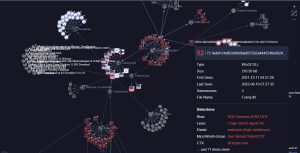
Understanding the infrastructure of the FunnySwitch backdoor is critical in mitigating the threat it poses. Below is a high-level overview of how the FunnySwitch backdoor operates and how it can be detected.
Initial Infection: The malware typically enters the target system through phishing emails, malicious downloads, or vulnerable software. Once on the system, it establishes a connection with a remote C&C server.
Persistence: Once installed, FunnySwitch maintains persistence on the compromised system by modifying system configurations, adding registry keys, or deploying other backdoor components to avoid detection.
Command & Control: The malware continuously communicates with its remote C&C infrastructure, allowing attackers to send commands, exfiltrate data, and deploy additional payloads.
Exfiltration: In many cases, FunnySwitch is used to steal sensitive intellectual property or data, which is then exfiltrated to the attacker’s server.
Lateral Movement: Attackers often use the backdoor to move laterally within an organization’s network, escalating privileges and compromising additional systems.
Data Theft: The ultimate goal of the FunnySwitch backdoor is often to steal intellectual property, sensitive data, or credentials for further exploitation.
PEStudio Analysis of the Malicious Backdoor
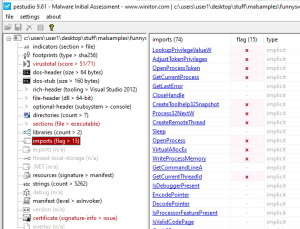
As part of our ongoing efforts to identify and mitigate threats, our team recently analyzed the file associated with the hash 12F1262FD1BCAE16A798D3ABEE2909C0 using PEStudio, a powerful tool for static analysis of Windows executables. During the investigation, we discovered that the file exhibits suspicious characteristics that point to malicious intent. Notably, it imports a number of high-risk functions such as OpenProcess, VirtualAllocEx, and AdjustTokenPrivilege. These functions are commonly used by malicious actors to interact with and manipulate other processes within a system, bypassing security mechanisms to escalate privileges, execute payloads, or hide malicious activity.
OpenProcess allows an attacker to gain access to any running process, enabling them to read and write to the memory of that process.
VirtualAllocEx is frequently used to allocate memory within a target process, which can be exploited to inject malicious code.
AdjustTokenPrivilege gives an attacker the ability to change the privileges of a process, often used to elevate their access rights.
These findings strongly suggest that the file in question is designed for advanced attacks, such as privilege escalation or covert operations within the system. By identifying these behaviors early through tools like PEStudio, we can take proactive steps to block such threats and fortify our clients’ infrastructures against sophisticated malware. This highlights the importance of ongoing vigilance and comprehensive analysis in defending against emerging threats.
Defending Against the FunnySwitch Backdoor
Given the complexity and stealth of the FunnySwitch backdoor, defending against it requires a multi-layered approach:
Endpoint Protection: Ensure that all systems are running updated antivirus/anti-malware software that can detect and block known malicious files.
Network Monitoring: Implement network intrusion detection systems (IDS) and intrusion prevention systems (IPS) to detect and block suspicious communication between infected systems and remote C&C servers.
Patch Management: Regularly update and patch all systems and software to reduce the chances of exploitation through known vulnerabilities.
Access Controls: Use strict access controls to limit which users can access sensitive systems. Multi-factor authentication (MFA) can further reduce the risk of unauthorized access.
Incident Response: Establish a comprehensive incident response plan that includes rapid identification and containment of compromised systems, followed by eradication and recovery.
Conclusion
The FunnySwitch (or GodRouter) backdoor poses a significant threat to organizations worldwide, particularly due to its links to the Winnti hacking group and its primary focus on intellectual property theft. By understanding the infrastructure of this threat and taking proactive measures to block the relevant IOCs, organizations can significantly reduce the risk of compromise.
Stay vigilant, implement strong security practices, and ensure that your team is aware of the latest threats in order to defend against this advanced and persistent threat.