Vintage Malice: Unmasking APT29’s Wine-Tasting Trap
APT29 a notorious Russian cyber espionage group has recently targeted European diplomats using GRAPELOADER malware.

APT29 Targets Diplomats with GRAPELOADER Malware: Uncovering the Threat with Graph Analysis
APT29 a notorious Russian cyber espionage group has recently targeted European diplomats using GRAPELOADER malware. The attackers used a seemingly innocuous wine-tasting invitation as a lure, drawing in unsuspecting victims. But what’s lurking behind this social engineering attack?
Let’s take a deep dive into this sophisticated campaign and explore how a comprehensive infrastructure mapping approach can help identify, mitigate, and prevent future breaches.
The GRAPELOADER Malware: An Overview
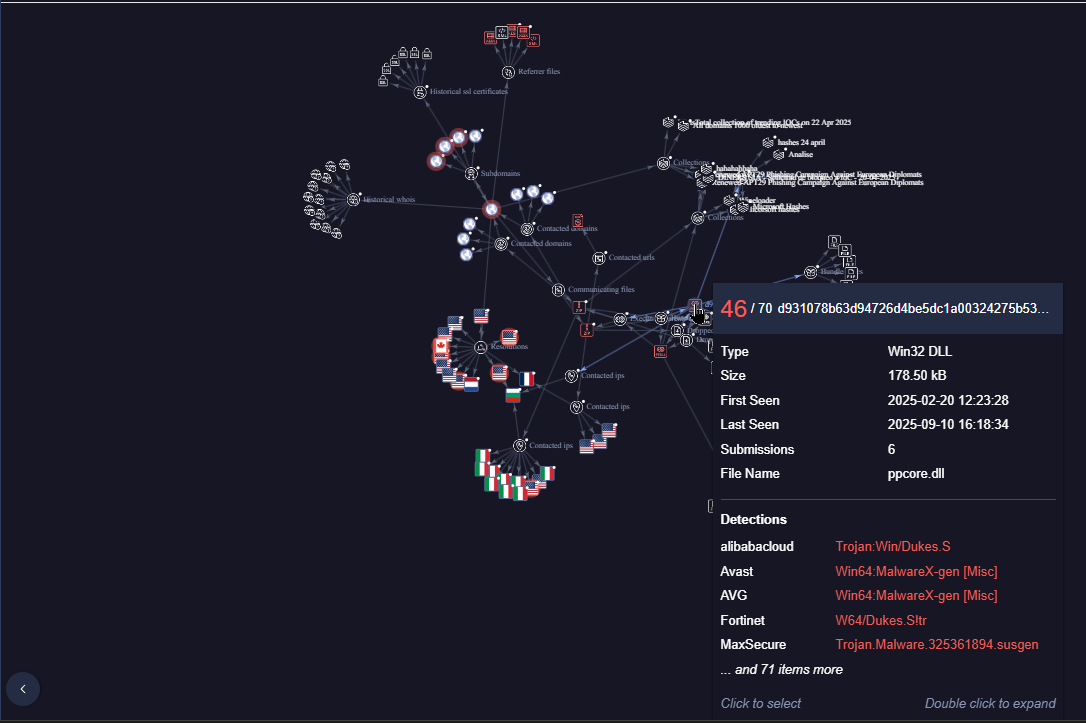
GRAPELOADER is a sophisticated piece of malware that has been associated with APT29 (also known as Cozy Bear), a group with ties to Russian state-sponsored cyber activities. This malware is distributed using well-crafted phishing campaigns that convince targets to open malicious attachments disguised as documents related to wine-tasting events.
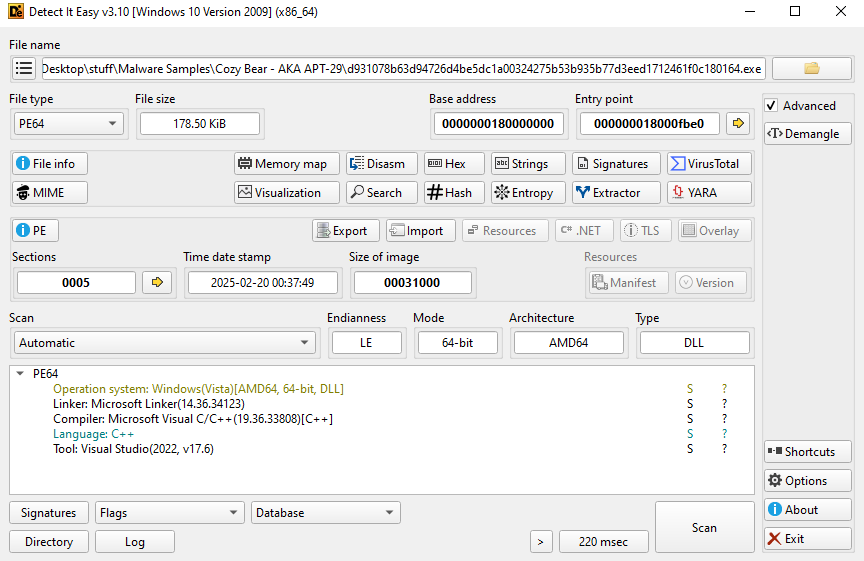
The file of interest, identified by its name d931078b63d94726d4be5dc1a00324275b53b935b77d3eed1712461f0c180164.exe, is a PE64 executable designed to run on Windows (Vista or newer). Below are key findings from an investigation of this malware using forensic tools like Pestudio:
Key Malware Indicators
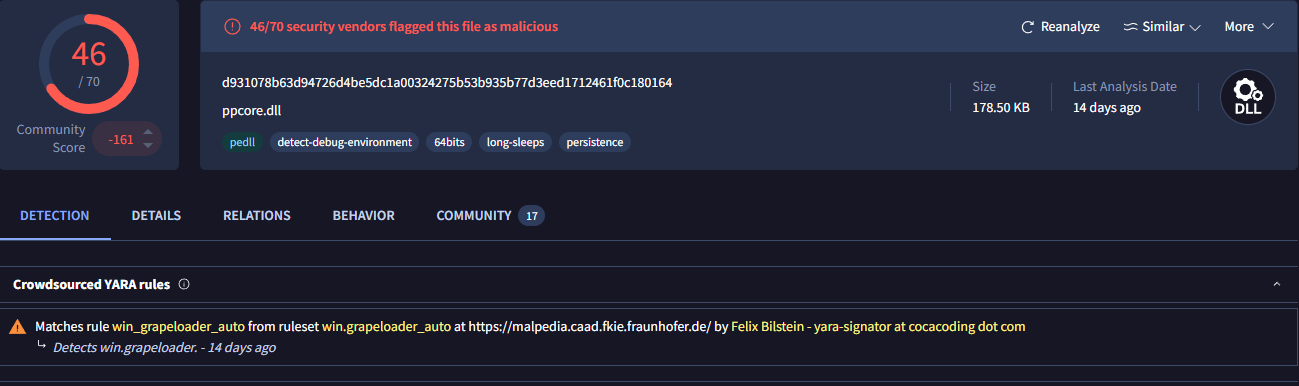
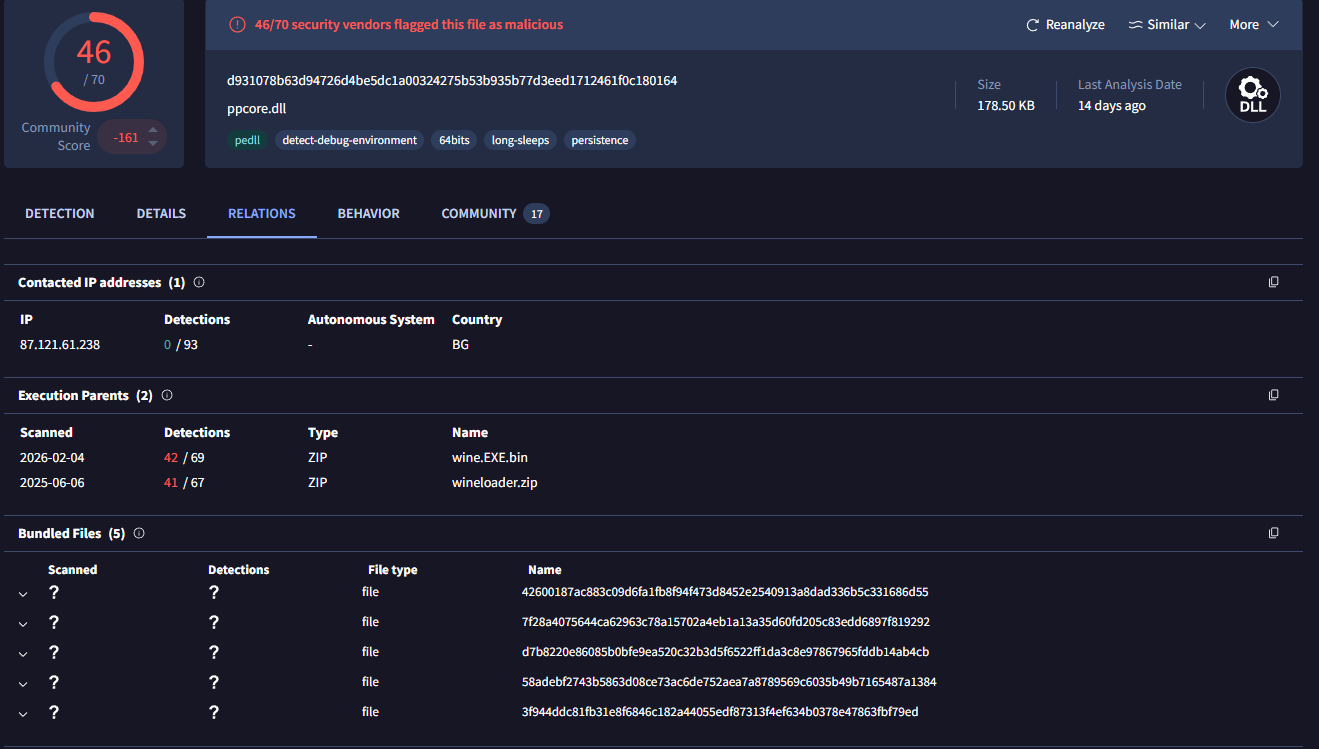
VirusTotal Score: The file achieved a 46/70 malicious detection score. This indicates that 46 out of 70 security vendors flagged the file as malicious. While the score is high, it’s not perfect, making it difficult for traditional antivirus solutions to catch every instance of the malware.
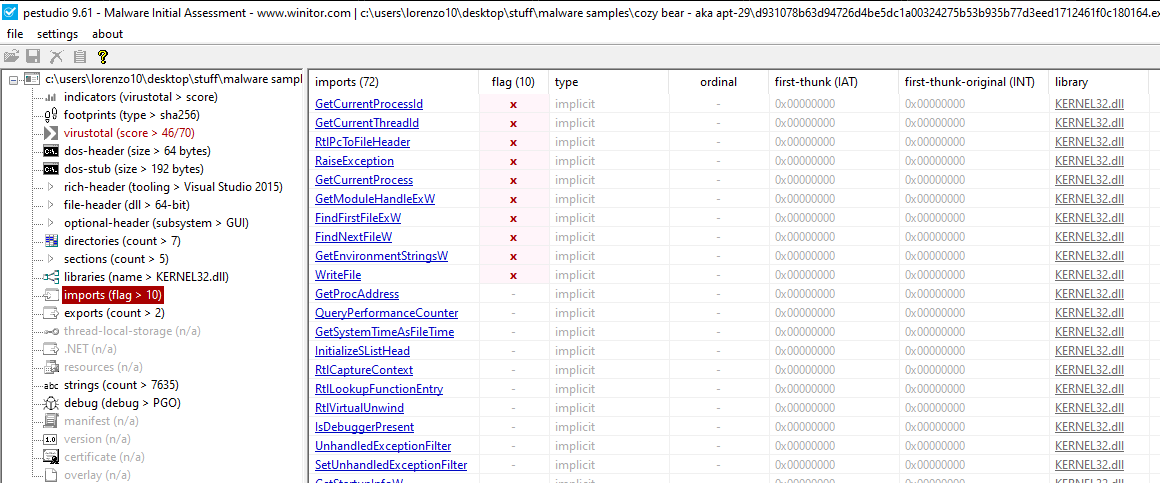
Malicious Imports: The malicious imports observed include several system calls like GetCurrentProcessId, WriteFile, and GetCurrentThreadId. These functions are commonly used in malware to manipulate system processes and execute malicious tasks. Detection of these imports often signals that a file is trying to access or manipulate key system functions.
PE File Structure:
Compiler: Microsoft Visual C/C++ (19.36.33808)
Linker: Microsoft Linker (14.36.34123)
Language: C++ (likely used for efficient, low-level system manipulation)
Operating System: Windows (Vista, AMD64 64-bit)
File Hash:
MD5: e025fa8354968f298af3f6ef2f22d7d3
SHA-1: b4221c83a3fffe7bc358dfc613c3e58fcc522a23
SHA-256: d931078b63d94726d4be5dc1a00324275b53b935b77d3eed1712461f0c180164
These cryptographic hash values help security researchers uniquely identify the malware sample.
Detailed Analysis
Operating System Compatibility:
GRAPELOADER has been developed for Windows (Vista or later) operating systems and compiled using Microsoft Visual Studio 2022.Malicious Behavior:
Upon execution, the malware opens a backdoor, communicates with remote command and control servers, and downloads additional payloads, often leading to data exfiltration and espionage.File Structure:
The malware’s DLL (Dynamic-Link Library) format allows it to interact directly with other applications and system resources. The PE64 header suggests it is designed to target 64-bit Windows environments, making it effective against more recent systems.
CAPA Analysis: A Deeper Dive into GRAPELOADER’s Capabilities
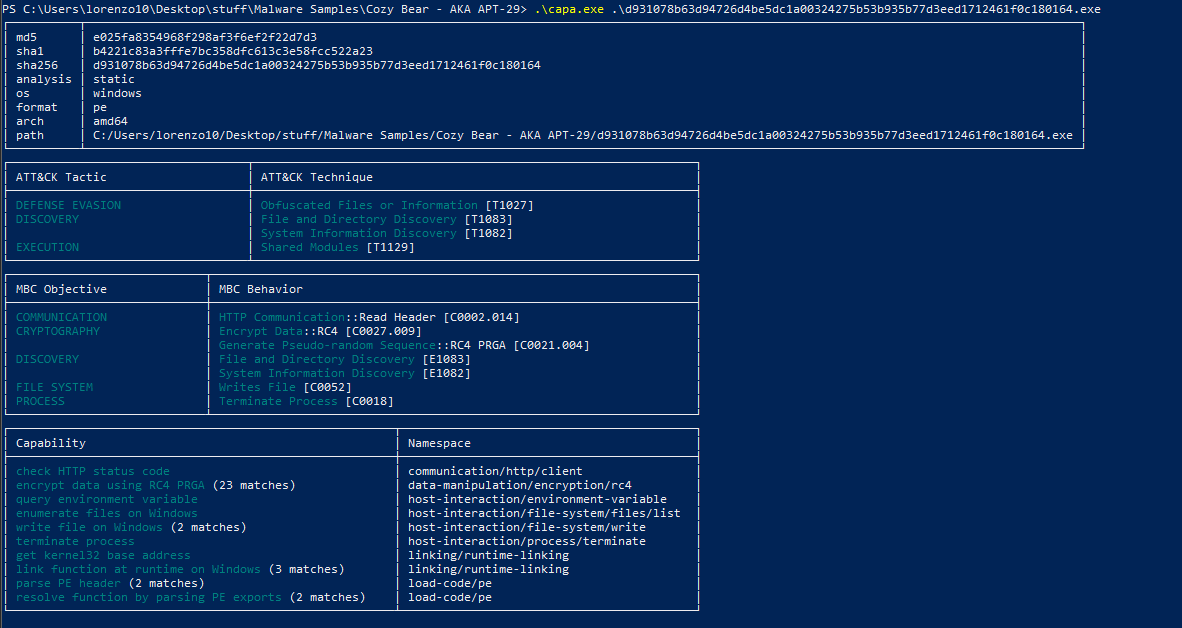
By running CAPA on the sample d931078b63d94726d4be5dc1a00324275b53b935b77d3eed1712461f0c180164.exe, we can get a more detailed understanding of its behavior. Here’s a summary of the findings from the CAPA analysis:
File Metadata:
| Attribute | Value |
|---|---|
| MD5 | e025fa8354968f298af3f6ef2f22d7d3 |
| SHA1 | b4221c83a3fffe7bc358dfc613c3e58fcc522a23 |
| SHA256 | d931078b63d94726d4be5dc1a00324275b53b935b77d3eed1712461f0c180164 |
| Analysis | Static |
| OS | Windows |
| Format | PE (Portable Executable) |
| Arch | AMD64 (64-bit architecture) |
| Path | C:/Users/lorenzo10/Desktop/stuff/Malware Samples/Cozy Bear – AKA APT-29/d931078b63d94726d4be5dc1a00324275b53b935b77d3eed1712461f0c180164.exe |
ATT&CK Tactics and Techniques:
| Tactic | Technique |
|---|---|
| Defense Evasion | Obfuscated Files or Information [T1027] |
| Discovery | File and Directory Discovery [T1083] |
| System Information Discovery [T1082] | |
| Execution | Shared Modules [T1129] |
MBC Objectives and Behaviors:
| MBC Objective | MBC Behavior |
|---|---|
| Communication | HTTP Communication::Read Header [C0002.014] |
| Cryptography | Encrypt Data::RC4 [C0027.009] |
| Generate Pseudo-random Sequence::RC4 PRGA [C0021.004] | |
| Discovery | File and Directory Discovery [E1083] |
| System Information Discovery [E1082] | |
| File System | Writes File [C0052] |
| Process | Terminate Process [C0018] |
Detailed Capabilities:
| Capability | Namespace |
|---|---|
| Check HTTP status code | communication/http/client |
| Encrypt data using RC4 PRGA (23 matches) | data-manipulation/encryption/rc4 |
| Query environment variable | host-interaction/environment-variable |
| Enumerate files on Windows | host-interaction/file-system/files/list |
| Write file on Windows (2 matches) | host-interaction/file-system/write |
| Terminate process | host-interaction/process/terminate |
| Get kernel32 base address | linking/runtime-linking |
| Link function at runtime on Windows (3 matches) | linking/runtime-linking |
| Parse PE header (2 matches) | load-code/pe |
| Resolve function by parsing PE exports (2 matches) | load-code/pe |
These findings show how GRAPELOADER employs various techniques to evade detection and establish persistence within the target system. By utilizing RC4 encryption, the malware ensures secure communication with its command and control servers. It also performs file system enumeration and process termination, allowing it to maintain control of the system while hiding its presence.
A Closer Look at the Infrastructure: Mapping APT29’s Attack
To fully understand the extent of this threat, we can map out its infrastructure. The attack seems to involve a multi-layered approach, starting with malicious email attachments and progressing to complex server interactions for data exfiltration. The malware is also capable of leveraging bundled files and ZIP archives, which increase the attack’s effectiveness by evading basic security filters.
Key Infrastructure Elements to Monitor:
IP addresses:
87.121.61.238
Domains:
bakenhof.com
bravecup.com
ophibre.com
silry.com
Indicators of Compromise (IOCs) to Block
To raise awareness and help organizations block the threat, here’s a table of IOCs (Indicators of Compromise) related to GRAPELOADER malware. Blocking these IOCs can help prevent the malware from infiltrating your network.
| Type | IOC Value |
|---|---|
| FileHash-MD5 | a89b9bdf5f28f4380f383ee199401bdc |
| FileHash-MD5 | e025fa8354968f298af3f6ef2f22d7d3 |
| FileHash-MD5 | e06fbace9c2297e47e6bf991f2681b2b |
| FileHash-MD5 | f474f6cd156e53a994ae3d25dcecb50c |
| FileHash-SHA1 | 3a7b4a507db8ac2aa59c83a59dcf1242411d14f5 |
| FileHash-SHA1 | 56248469a7c079c4174f6c8351b48294bd7a57e0 |
| FileHash-SHA1 | 5a3bd2f12875098bd06b9f5a5a9405d9cf3af837 |
| FileHash-SHA1 | b4221c83a3fffe7bc358dfc613c3e58fcc522a23 |
| FileHash-SHA256 | 24c079b24851a5cc8f61565176bbf1157b9d5559c642e31139ab8d76bbb320f8 |
| FileHash-SHA256 | 420d20cddfaada4e96824a9184ac695800764961bad7654a6a6c3fe9b1b74b9a |
| FileHash-SHA256 | 653db3b63bb0e8c2db675cd047b737cefebb1c955bd99e7a93899e2144d34358 |
| FileHash-SHA256 | 78a810e47e288a6aff7ffbaf1f20144d2b317a1618bba840d42405cddc4cff41 |
| FileHash-SHA256 | 85484716a369b0bc2391b5f20cf11e4bd65497a34e7a275532b729573d6ef15e |
| FileHash-SHA256 | adfe0ef4ef181c4b19437100153e9fe7aed119f5049e5489a36692757460b9f8 |
| FileHash-SHA256 | d931078b63d94726d4be5dc1a00324275b53b935b77d3eed1712461f0c180164 |
| URL | https://bakenhof.com/invb.php |
| URL | https://silry.com/inva.php |
| Domain | bakenhof.com |
| Domain | bravecup.com |
| Domain | ophibre.com |
| Domain | silry.com |
Conclusion: Securing Against APT29’s GRAPELOADER Malware
The APT29 GRAPELOADER malware is a clear and present threat to organizations, particularly in diplomatic and government sectors. Using graph analysis tools to map the attack’s infrastructure allows organizations to gain valuable insights into how these attacks unfold and how they can defend against them.
By blocking the indicators mentioned above, security teams can strengthen their defenses and reduce the risk of successful exploitation. Staying vigilant and continually updating security measures are key to mitigating the evolving threat landscape presented by APT29 and other sophisticated adversaries.
Stay secure and keep your defenses strong!